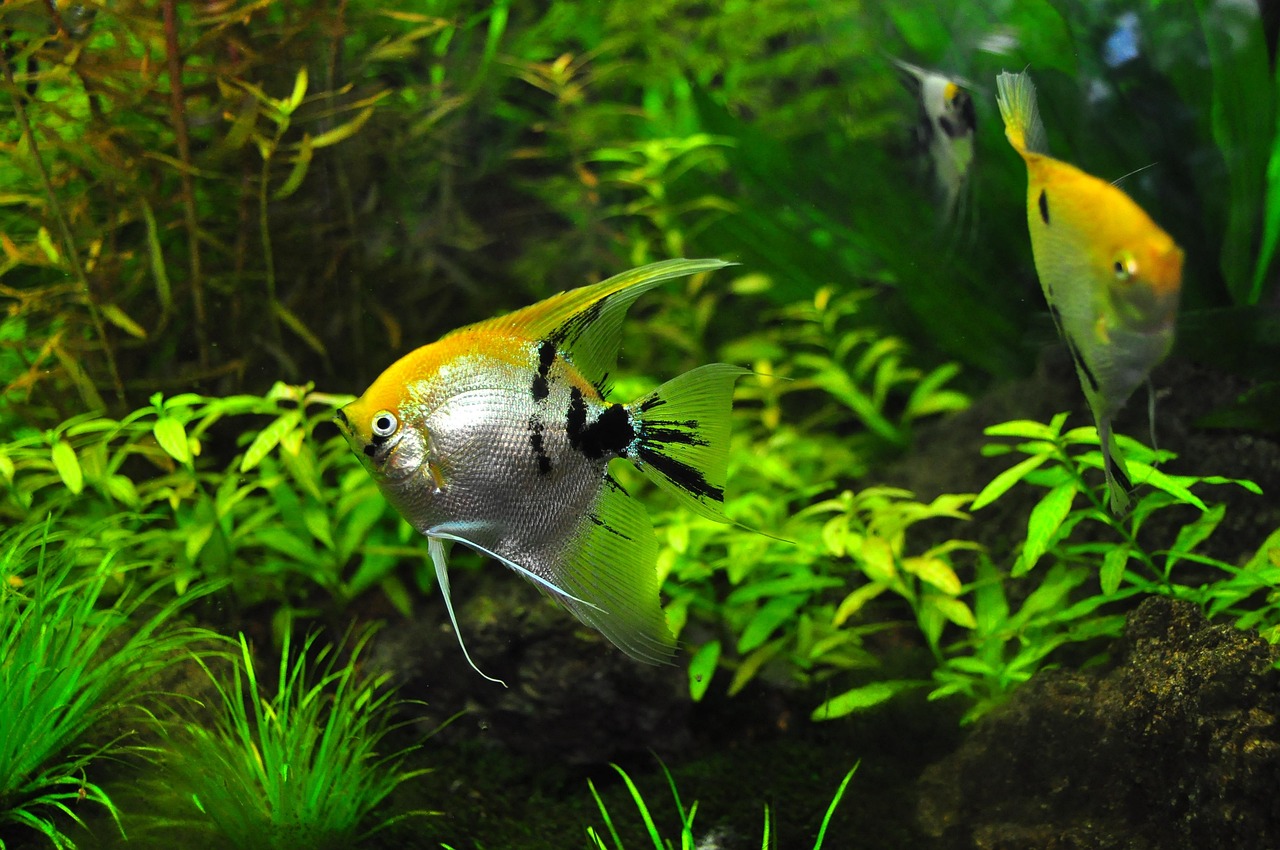
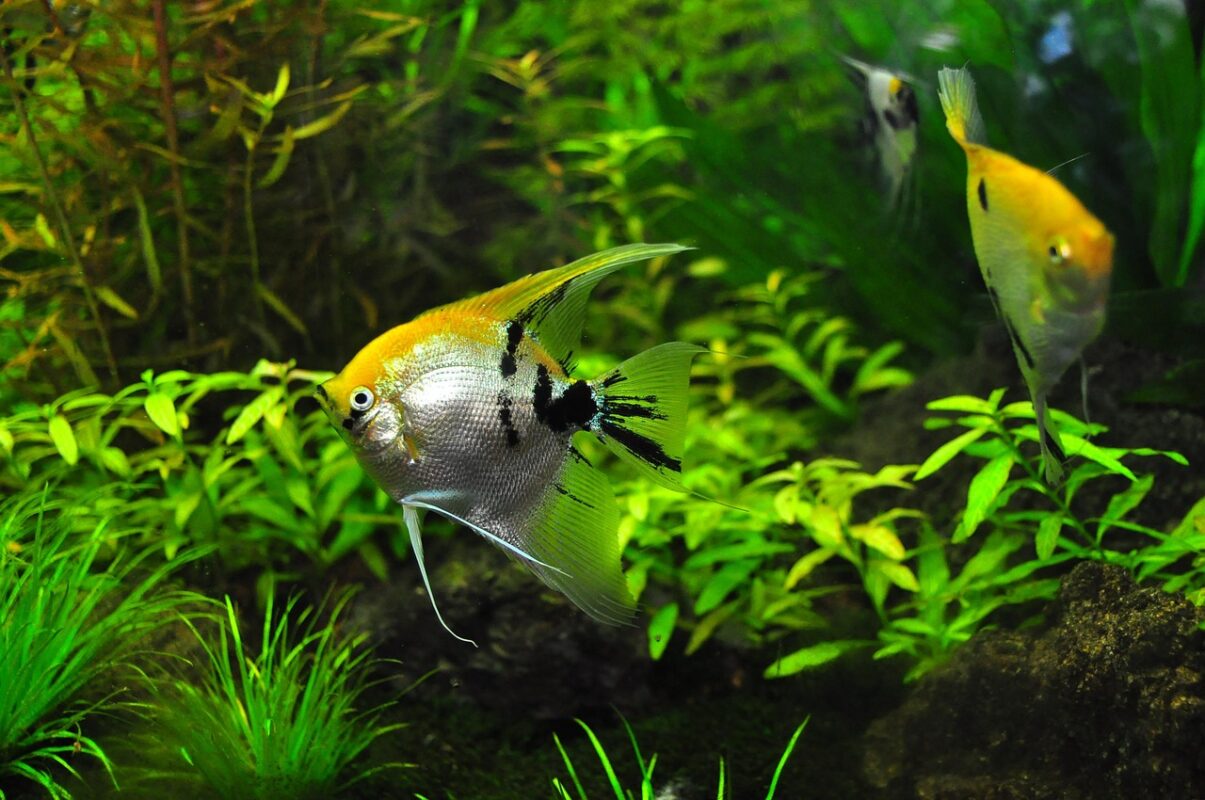
Artificial planting has a reputation problem, and most of it is earned by placement rather than by the plants. A tank with six different colours of plastic spaced evenly across the back glass looks artificial because nothing in nature grows that way. The same plants, grouped and layered properly, read as a planted tank from three feet away.
Build in three depths
Real planting sorts itself by height because of light competition. Copy that.
- Background: the tallest pieces, along the back glass, tall enough to hide equipment. This is where filter intakes and heaters disappear.
- Midground: medium height, arranged in clumps rather than a line, breaking the sightline between front and back.
- Foreground: low, open, and mostly empty. The open space is what makes the rest read as depth.
The most common beginner layout — everything the same height, evenly spaced — flattens the tank. Varying height alone fixes most of it.
Group in odd numbers
Three, five or seven stems of the same plant clustered together look like one established colony. One of each of seven different plants looks like a display rack. Buy fewer varieties and more of each, and let clumps touch and overlap.
Keep the colour discipline
Pick a dominant green and let it carry most of the volume. Introduce at most one accent colour, and use it in one or two places rather than scattered. A single red midground clump against green reads as a focal point; five red clumps read as decoration.
The same restraint applies to ornaments. One good piece placed off-centre beats four competing for attention. Our decor and artificial plants are all aquarium-grade and intended for permanent submersion — not everything sold as an ornament is, and non-aquarium plastics can leach.
Use the rule of thirds
Divide the front glass into thirds horizontally and vertically. Put your main feature — the tallest plant group or the largest ornament — on one of the vertical lines rather than dead centre. Central symmetry reads as a display; off-centre reads as a scene.
Anchoring, and the floating plant problem
Most artificial plants come on a weighted base designed to sit under the substrate. Bury the base properly, at least an inch deep. Bases that are half-buried are what pop loose two weeks later when a fish digs.
For very light pieces, or in a sand tank, tie the base to a small flat stone with cotton thread before burying it. The thread is invisible within days.
The two things that give it away
Algae film
Artificial plants collect a green or brown film exactly as real ones do, and because the surfaces are smooth it shows more. Pull them out during a water change every month or two and scrub with a soft brush in old tank water. Never use soap or household cleaner, and never bleach anything you are putting back in a tank without a long rinse and a dechlorinator soak.
Faded colour
Cheap dyes fade under aquarium lighting within a year, and a faded plastic plant is unmistakable. This is where quality shows: better plants use pigment through the material rather than a surface coating.
Where artificial genuinely beats live
This is not a compromise in every tank. Artificial planting wins outright with fish that eat or uproot live plants — goldfish, most cichlids, large plecos. It wins in tanks with low light where live plants would struggle. It wins in a hospital or quarantine tank, where you need cover you can strip out and disinfect. And it wins when the person keeping the tank does not want a second hobby attached to the first.
Leave swimming room
The most common mistake after even spacing is overplanting. Fish need open water, and a tank packed wall to wall stresses active swimmers. Aim for roughly a third of the footprint planted, a third hardscape and open substrate, and a third clear water. It looks better and it keeps flow moving, which stops debris settling in dead corners.
Mixing artificial with live
Nothing says a tank has to be one or the other, and the hybrid often looks best. A common approach is live foreground and midground — the plants that are easy, like anubias and java fern tied to hardscape — with artificial planting doing the tall background work where light is weakest and live stems tend to go leggy.
The trick is matching leaf character rather than colour. A fine-leaved artificial background behind broad-leaved live plants reads as depth. Broad artificial leaves behind broad live ones invite direct comparison, and the plastic loses.
Planning around equipment
Decide where the filter intake, the heater and the thermometer go before you plant, not after. Tall background planting exists partly to hide them, and it only works if the equipment is already in place when you position the plants. Leave a hand’s width of clear substrate in front of any equipment you will need to reach; the alternative is uprooting three plants every time you service the heater.
Flow matters too. Dense planting in a corner where the filter return does not reach creates a dead zone where detritus settles and film algae takes hold. Keep the densest planting where there is at least some current passing through it.
Getting it wet
Place everything before you fill. Rearranging in a full tank means wet sleeves and a cloud of substrate dust for the rest of the day. If you are setting up from scratch, our starter kits and glass tanks pages have the gallon ratings, and there is a full setup-order guide elsewhere on this journal.
Questions about a specific layout are welcome — send us the tank dimensions and what is going in it. The FAQ covers the questions we get asked most, and the full range is on the shop page.
From our shelves
Products in this store that relate to what is covered above:
Prices are in US dollars. Delivery timings are on our shipping policy page and the return and refund policy sets out the window if something is not right.
Related reading